blog
Dead Hang: How Long to Hold and What It Builds
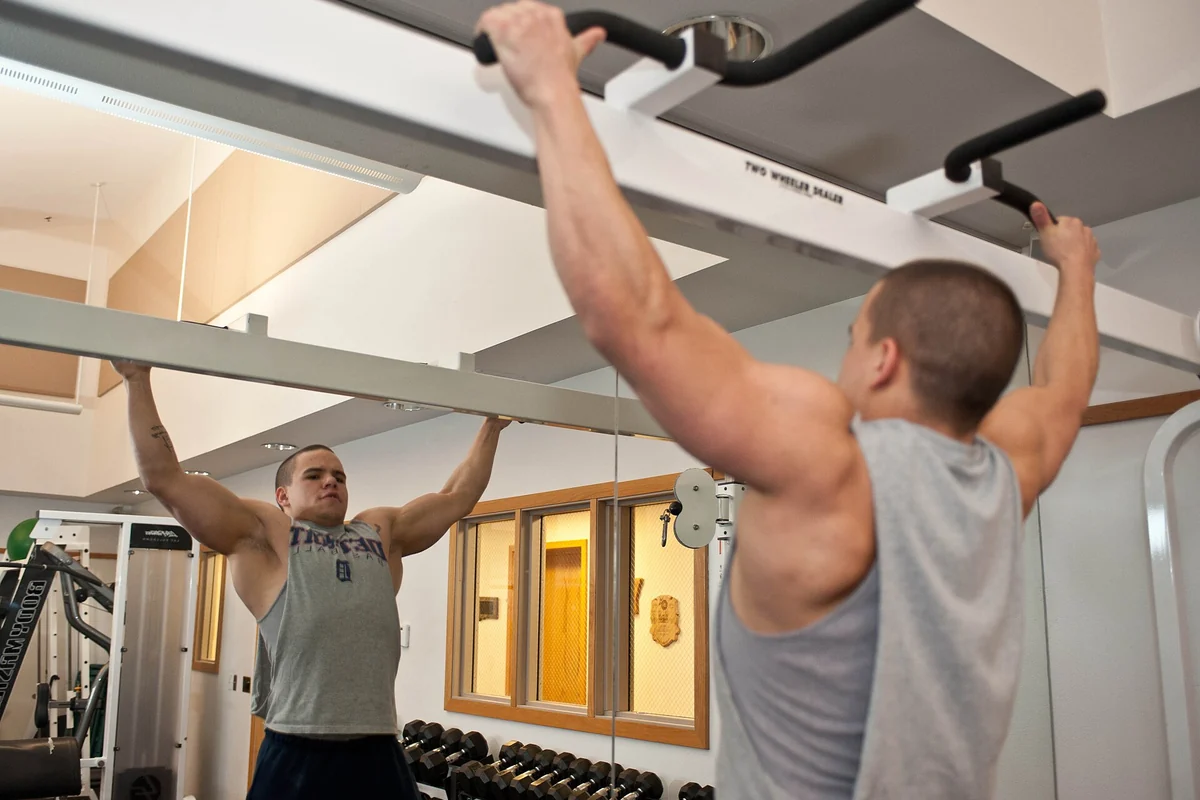
Photo: U.S. Air Force, public domain, via Wikimedia Commons
A dead hang is hanging from a bar with straight arms and the body still. It is the first rung under a pull-up, it trains the grip and the shoulder position the pull depends on, and 30 seconds is the target that gets a beginner through the rungs that follow.
 Say where you stand. RepMaxing sets the target. coming soon
 What is a dead hang?
A dead hang is hanging from a bar with straight arms, feet clear of the floor and the body still. Nothing moves. The shoulders sit where gravity puts them, the elbows stay locked out, and the only job is to keep holding on.
It is the first rung in how to do your first pull-up and the cheapest exercise on this site, because the equipment is a bar and the technique is nothing. That combination is why it is also the rung people skip.
What does a dead hang actually train?
It trains 3 things at once, and only 1 of them is obvious.
- The grip, specifically the endurance of the finger flexors rather than a crushing squeeze.
- The shoulder position, by putting the arm overhead under load and asking the joint to tolerate it.
- Time under the bar, which is the part beginners miss. A hang is the only pulling exercise you can do before you can pull.
Sepehri Rahnama et al. (2025) randomised 30 physically inactive men into 8 weeks of pull-up training with different additions and reported that the group adding forearm work raised hang time by 55.3 percent and pull-up repetitions by 222.5 percent, while the group adding intervals improved least. Starting numbers were small, so a large percentage is a small absolute gain, and the direction is still the useful part.
How long should you hang?
Hang for 30 seconds to get through the early rungs, and treat 60 seconds as the milestone worth owning. Both are rules of thumb, and it is worth being blunt about why.
There is no norm table for hang time. Handgrip strength has one built from 2.4 million adults across 69 countries, published by Tomkinson et al. (2025), and it exists because a dynamometer asks everyone to squeeze the same device. A bar asks a 65 kilogram person and a 95 kilogram person to hold completely different loads, so the same seconds mean different things.
| Where you are | What to aim at | Why |
|---|---|---|
| Under 10 seconds | 20 seconds | Enough to start scapular pulls |
| 20 seconds | 30 seconds | Enough for the early rungs |
| 30 seconds | 60 seconds | The grip stops ending your sets |
| 60 seconds | Stop chasing it | The back and arms are the limit now |
The last row matters more than the first 3. Past a minute, extra hang time buys very little for a pull-up, and the work moves to inverted rows and negative pull-ups.
What does a hang time tell you about your strength?
Less than you would expect, and the closest measured cousin makes the point. Clemons et al. (2004) tested 60 college-age women on the flexed-arm hang alongside a lat pulldown 1 repetition maximum and repetitions to failure at 70 percent of it. No significant relationship appeared between any hang variation and absolute strength or muscle endurance. Every variation did correlate with strength relative to body mass, most strongly at r = 0.72.
Two cautions before anyone stretches that. The flexed-arm hang holds the chin above the bar with bent elbows, which is a different task from a dead hang. And the participants were 60 women, which is a narrow sample.
The honest reading is that a hang time is a measure of what you can hold relative to what you weigh. It is a useful personal marker and a poor way to compare yourself with anybody else.
Is grip strength worth training for its own sake?
Grip strength is one of the most studied simple markers in medicine, which is worth knowing even though it does not make your hang special. Leong et al. (2015) measured grip with a dynamometer in 139,691 people across 17 countries and reported a hazard ratio of 1.16 for all cause mortality per 5 kilogram reduction in grip strength.
Be careful with what that does and does not say. It measured a dynamometer squeeze, not a hang, and it is an association in a population rather than a promise about your training. Hanging from a bar is not a medical intervention. It is a good exercise that happens to sit next to a well evidenced marker, and the method for building the grip itself is in grip strength for pull-ups.
Dead hang or active hang?
Use both, for different jobs. A dead hang lets the shoulders sit passively and trains the grip and the tissue tolerance. An active hang pulls the shoulder blades down and back, lifts the chest slightly and switches on the muscles a pull-up starts with.
The active version has its own name and its own page: it is the scapular pull, covered in scapular pull-ups. Youdas et al. (2010) recorded the latissimus dorsi at 117 to 130 percent of a maximal contraction during a pull-up, so the muscle you are switching on is the main one.
One caution on the shoulder. Prinold and Bull (2016) tracked scapular movement in 11 regular pull-up trainees and reported that high arm elevation reduces the space under the acromion. A relaxed hang puts the arm at exactly that elevation. For most people that is fine and even useful, and for a shoulder that already hurts overhead it is a reason to start with short holds and the active version rather than long passive ones.
How do you train it?
Train it in 3 holds, 3 or 4 days a week, stopping each hold just before the fingers start to slide rather than at the moment they do. That frequency is a rule of thumb.
- Get set before you leave the floor. Overhand grip, roughly shoulder width, thumbs around the bar.
- Step off rather than jump. A jump starts the hold with a swing you then have to kill.
- Stay still. No kicking, no twisting. If the body swings, the set has become something else.
- Come down under control, with the feet, not by dropping.
If the bar is too low for straight legs, bend the knees and cross the ankles. Most doorway bars leave a taller person half on the floor, which is one of the limits covered in the pull-up bar guide.
To make it harder without more seconds, change the hold rather than the clock. Vigouroux et al. (2019) had climbers work on a gym bar, a large climbing hold and 4 smaller ones down to 10 millimetres, and the number of repetitions, the maximal arm power and the total mechanical work all fell significantly as the hold got smaller, with measurable finger flexor fatigue. A towel over the bar does the same thing for free. There was no difference between a standard gym bar and a large climbing hold, so a normal bar is already the easy end.
I hung for 24 seconds the first time I bothered to time it, and I would have guessed 45. What surprised me more was the second set: 14 seconds, barely half. That gap between the first hold and the third is the thing I now watch, because it moves long before the first number does, and it is the reason I do 3 holds rather than 1 long one.
Where does the dead hang lead?
It leads to the scapular pull, then the row, then the negative, then a first rep, in the order set out in how to do your first pull-up. It also unlocks hanging leg raises, where the grip is usually what ends the set. Once you have a rep, the targets are in how many pull-ups you should be able to do.
I left the hang out of RepMaxing on purpose. The app takes the rep counts you enter for pull-up, push-up and dip, 0 included, never a hang time, because seconds on a bar cannot tell you whether you can pull. A goal workout is 6 sessions ending in 1 attempt at a target computed from those numbers and held fixed until you reach it. The hang is how you make the first number stop being 0. The first goal workout, Foundation, is free.
Questions people actually ask
How long should you be able to dead hang?
30 seconds is enough to get through the early pull-up rungs and 60 seconds is a solid milestone, both rules of thumb. There is no published norm table for hang time the way there is for handgrip strength, so treat any number you read as a target rather than a standard.
What is a good dead hang time for a beginner?
Anything above 20 seconds is a working hang. From 0, aim at 30 seconds first. The useful comparison is your own hang from last month, not a figure from the internet, because hang time scales with body weight as well as with grip.
What is the difference between a dead hang and an active hang?
In a dead hang the shoulders are relaxed and the body simply hangs. In an active hang the shoulder blades are pulled down and back so the chest lifts slightly. The active version is the one a pull-up starts from, and it is trained as a scapular pull.
What are the benefits of dead hangs?
Grip endurance, shoulder position and time under the bar. Sepehri Rahnama et al. (2025) raised hang time by 55.3 percent and pull-up repetitions by 222.5 percent in 8 weeks in a group that added forearm work, which is the clearest argument for owning something to hang from.
Does hanging from a bar make you taller?
No. Spinal discs lose a little water through the day and take it back when the spine is unloaded, so you may measure a few millimetres more straight afterwards. It reverses within hours of standing and walking, and adult height does not change.
Which grip should you use for a dead hang?
An overhand grip at roughly shoulder width for the default. A thicker or smaller hold makes it much harder: Vigouroux et al. (2019) found repetitions, arm power and total work all dropped significantly as the hold got smaller, with the finger flexors fatiguing measurably.
Can you do dead hangs every day?
Most people can, because a hang is low in total load compared with a pull. 3 holds on 3 or 4 days a week is plenty, as a rule of thumb, and stopping before the fingers slide matters more than the frequency.
References
- Relationships between the flexed-arm hang and select measures of muscular fitness (Clemons et al., J Strength Cond Res, 2004)
- Comparative effects of core versus forearm training on pull-up repetition performance in physically inactive males (Sepehri Rahnama et al., Sports, 2025)
- Performing pull-ups with small climbing holds influences grip and biomechanical arm action (Vigouroux et al., J Sports Sci, 2019)
- Prognostic value of grip strength: findings from the Prospective Urban Rural Epidemiology (PURE) study (Leong et al., Lancet, 2015)
- International norms for adult handgrip strength: a systematic review of data on 2.4 million adults (Tomkinson et al., J Sport Health Sci, 2025)
- Surface electromyographic activation patterns and elbow joint motion during a pull-up, chin-up, or Perfect-Pullup rotational exercise (Youdas et al., J Strength Cond Res, 2010)
- Scapula kinematics of pull-up techniques: avoiding impingement risk with training changes (Prinold and Bull, J Sci Med Sport, 2016)