blog
Which Pull-Up Bar, and Why the Doorway One Has a Ceiling
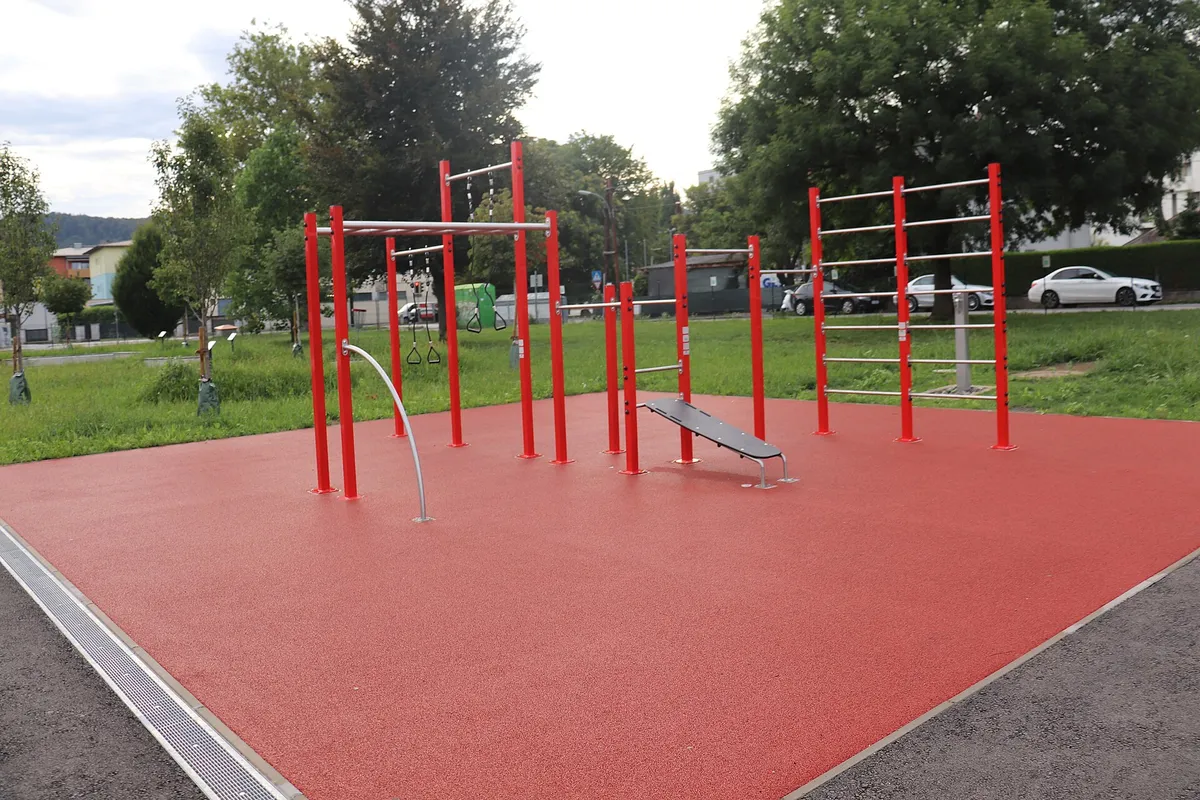
Photo: Xaverpedia, CC BY 4.0, via Wikimedia Commons
A doorway bar is a real help for the first weeks and it has a ceiling. It fixes your grip width, usually leaves your knees bent because the frame is too low, carries a weight limit, and cannot take a dip. Plan on a fixed bar at a gym or an outdoor park for everything past that.
 Say where you stand. RepMaxing sets the target. coming soon
 What kinds of pull-up bar are there?
There are 4 kinds, and they differ in how they are fixed, not in what they do for the muscles.
| Kind | How it holds | Grip widths | Dips possible |
|---|---|---|---|
| Doorway, leverage type | Wedges against the frame under your weight | 1, fixed | No |
| Doorway, screw-mounted | Bolted into the frame or wall around the door | 1, fixed | No |
| Wall or ceiling mounted | Bolted into masonry | Usually several | Only with a separate station |
| Free-standing rig or park bar | Its own frame, or set in the ground | Several, plus parallel bars | Yes on most |
The muscles do not care which one you hang from. Youdas et al. (2010) measured the lats at 117 to 130 percent of a maximal contraction during a pull-up, and that figure does not change because the bar is screwed into a door frame. What changes is what the bar lets you do.
What does a doorway bar do well?
A doorway bar does the first weeks well, and that is not a small thing. It gives you a place to hang, which is the first rung in how to do your first pull-up and the most specific grip exercise there is. Sepehri Rahnama et al. (2025) randomised 30 untrained men into 8 weeks of pull-up training with different supplements and found the forearm group raised hang time by 55.3 percent and pull-up repetitions by 222.5 percent, which is the clearest argument there is for owning something you can hang from.
It also handles scapular pulls and negatives, which covers the first 2 of the 5 rungs. For someone starting from 0, that is a couple of months of useful work for the price of a cheap bar.
Where does a doorway bar stop?
It stops at 4 limits, and a beginner meets all of them eventually.
- Headroom. A door frame sits at roughly 2 metres. A person of average height hanging from it has bent knees, and a tall person has their feet on the floor. Bent knees change nothing about which muscles work, but they make the full dead hang at the bottom harder to judge honestly, which is exactly the part the form standard depends on.
- One grip width. The bar is as wide as the door. You cannot go wider, narrower, or neutral. That matters because grip is the one variable the research keeps flagging: Prinold and Bull (2016) found the wide grip showed a shoulder blade pattern linked to impingement risk, and Urbanczyk et al. (2020) found grip choice changes which muscles carry the load. With a doorway bar you get the width the door gives you.
- A weight limit. Every doorway bar states one, and it includes anything you add. The moment you want weighted pull-ups, the bar is usually the first thing to run out.
- No dips. Dips need 2 parallel supports with space to sink between them. McKenzie et al. (2022) measured peak triceps activation at 1.04 millivolts on a proper bar dip against 0.83 on a bench, which is why the bar version is the progression. A door frame offers neither.
Point 4 is the one people underestimate. A beginner programme rests on 3 movements, pull, push and dip, as set out in how to start calisthenics. A doorway bar covers 1 of them.
Does the bar itself change the exercise?
The bar changes the exercise mainly through its thickness, and thicker is harder rather than better. Vigouroux et al. (2019) had climbers perform pull-ups on a gym bar, a large climbing hold and 4 small holds down to 10 millimetres, and found the number of repetitions, the maximal arm power and the total mechanical work all fell significantly as the hold got smaller, with the finger flexors fatiguing measurably. The same paper found no difference between a standard gym bar and a large climbing hold.
The practical reading: a standard bar, roughly 3 centimetres across, is the version that lets your back rather than your fingers decide when the set ends. That is what a beginner wants. If you want the grip to be the target, a towel over the bar does it for free, as described in grip strength for pull-ups.
Grip width behaves the same way. Andersen et al. (2014) tested narrow, medium and wide grips in the lat pulldown in 15 men and found similar lat, trapezius and infraspinatus activation across all 3, with the narrow and medium grips lifting more weight. So a doorway bar’s fixed, fairly narrow width is not a training problem. It is a variety problem, and only later.
What should you check before trusting one?
Check 5 things, and check them before your feet leave the floor.
- The stated weight limit, against your body weight plus anything you might add.
- How it mounts. A leverage bar holds because your weight presses it against the frame, which is why its instructions forbid swinging and kipping. A screw-mounted bar does not care.
- The frame itself. Plasterboard around a door is not masonry. If the frame flexes when you pull on it by hand, it will flex under 80 kilograms.
- The headroom, by hanging with straight arms and seeing where your feet are.
- After the first session, the frame again. Dents and loosened screws show up early or not at all.
None of that is a study result; it is the sensible order for putting your weight on something (rule of thumb).
When do you leave the doorway behind?
You leave it when the bar starts deciding your training instead of your body. That is usually at 1 of 3 moments: when you want to add weight, when you want to train dips on the same day as pulls, or when the bent knees at the bottom stop you judging a full hang. Any of those means a fixed bar, and in practice that means a gym rack or an outdoor fitness park.
That is not a downgrade of the doorway bar, it is what it was for. It buys the first couple of months cheaply and then hands you over. Where the sessions go next is in the beginner calisthenics workout plan.
When I built RepMaxing I did not build anything about equipment into it, and that was deliberate: the app takes the rep count you enter for pull-up, push-up and dip, 0 included, and a goal workout is 6 sessions ending in 1 attempt at a target computed from those numbers and held fixed until you reach it. It does not care whether the bar is screwed into a door or set in concrete, only whether the number moves. The first goal workout, Foundation, is free.
Questions people actually ask
Are doorway pull-up bars any good?
For the first weeks, yes. They let you hang, do scapular pulls and negatives at home, which is exactly what a beginner needs. They stop working once you need a full hang with straight legs, a grip width you choose, or a dip, and none of those is unusual after a couple of months.
Is a doorway pull-up bar safe?
The screw-mounted kind is, within its stated weight limit. The leverage kind that wedges against the frame relies on your body weight pressing it in place, which is why the instructions forbid kipping and swinging. Read the limit, test it with a slow hang before you trust it, and check the frame afterwards.
What height do I need for a pull-up bar?
Enough that your feet clear the floor with straight legs. Most door frames are about 2 metres, which leaves a tall person hanging with bent knees. Bent knees change nothing about the muscles working, but they do make the bottom of the rep harder to keep honest.
Does the thickness of the bar matter?
It makes the exercise harder without making it better. Vigouroux et al. (2019) found the number of pull-ups, the peak power and the total work all dropped as the hold got smaller and harder to grip, with measurable finger flexor fatigue. A standard bar is the easy end, and that is where a beginner belongs.
Can I do dips on a doorway pull-up bar?
No. Dips need two parallel supports at hip height with space to sink between them. That is a different piece of equipment, and it is one of the reasons the doorway bar has a ceiling: it covers 1 of the 3 movements a beginner programme is built on.
Wall-mounted or free-standing?
Wall-mounted if you own the wall and it is masonry, because it is rigid, sits at a height you choose, and usually offers several grip widths. Free-standing if you cannot drill, accepting that the frame needs floor space and can rock if it is light.
Do I need a bar at all to start?
Not for the first rung. A dead hang needs a bar, but scapular pulls, inverted rows under a table and the whole push and dip side need none. What you cannot build without a bar is the pull itself, and that is the movement this site is named after.
References
- Performing pull-ups with small climbing holds influences grip and biomechanical arm action (Vigouroux et al., J Sports Sci, 2019)
- Scapula kinematics of pull-up techniques: avoiding impingement risk with training changes (Prinold and Bull, J Sci Med Sport, 2016)
- Avoiding high-risk rotator cuff loading: muscle force during three pull-up techniques (Urbanczyk et al., Scand J Med Sci Sports, 2020)
- Effects of grip width on muscle strength and activation in the lat pull-down (Andersen et al., J Strength Cond Res, 2014)
- Comparative effects of core versus forearm training on pull-up repetition performance in physically inactive males (Sepehri Rahnama et al., Sports, 2025)
- Bench, bar, and ring dips: do kinematics and muscle activity differ? (McKenzie et al., Int J Environ Res Public Health, 2022)