
blog
How to Increase Pull-Ups: From Your First Rep to 10
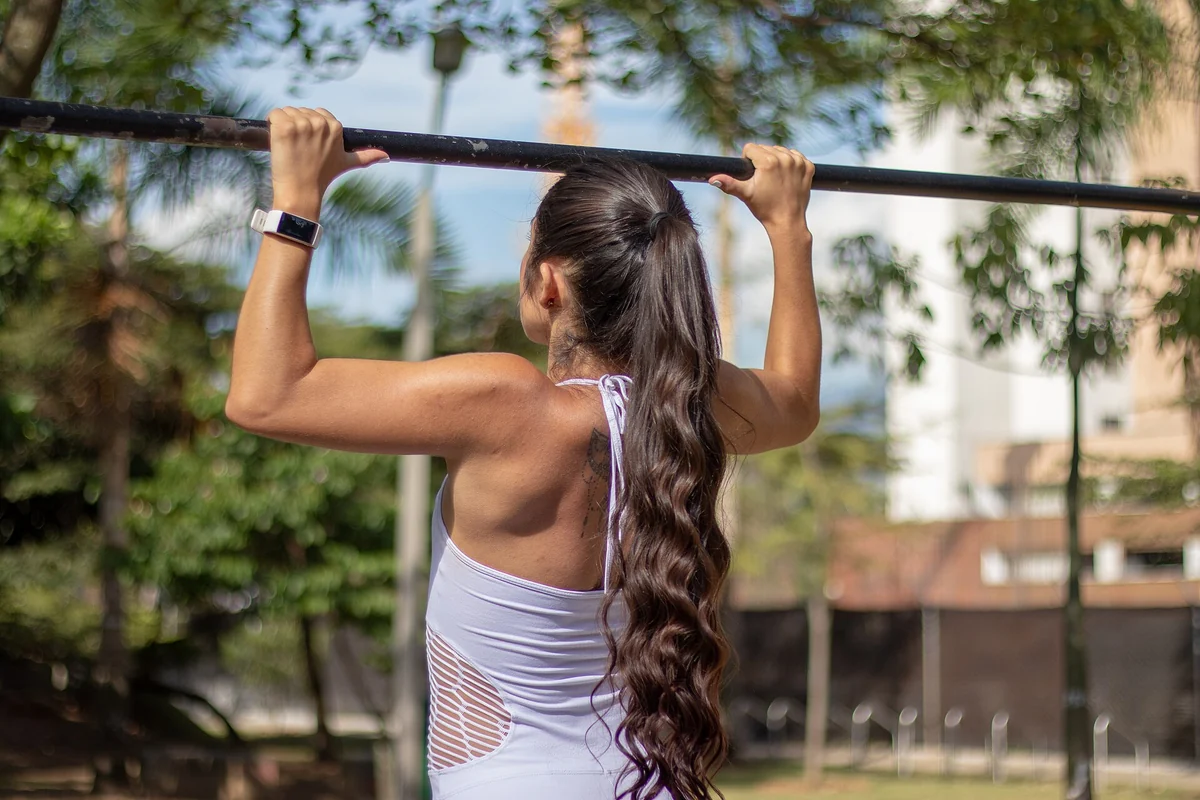
Photo: PTPioneer, CC BY 2.0, via Wikimedia Commons
To increase pull-ups, train them often and below your maximum, add a little volume each week, and test your maximum only once in a while with the same strict standard. The rep count rises with strength relative to body weight, so the grip, the volume and the scale all move it.
 Say where you stand. RepMaxing sets the target. coming soon
 What decides how many pull-ups you can do?
Your strength relative to your body weight decides it. A pull-up lifts your whole body, so 2 people with the same back can do very different numbers if they weigh different amounts.
Johnson et al. (2009) measured this directly in 35 college men and 23 college women by adding or taking away weight until each could manage exactly 1 pull-up. The men’s maximum averaged 1.16 times their body mass, the women’s 0.73. That relative figure is what the rep count rests on, and it gives you 3 levers to move it: get stronger, train the endurance of that strength, and carry less.
Why do most people stay stuck?
Most people stay stuck because every session turns into a test. They do as many pull-ups as they can, rest, do as many as they can again, and the number stays where it is. Each set is all-out, so the total work per week stays small and every session ends tired.
The other common trap is the opposite: the same 3 sets of 5 for 2 months. The body adapts to that within weeks and then has no reason to change. Both problems have the same fix, which is to train below the maximum and let the volume rise.
How should you train to increase pull-ups?
Train in several sets below your maximum, 2 or 3 times a week, and add a little each week. These numbers are a rule of thumb built on the research below.
| Your maximum | Sets per session | Reps per set | Rest |
|---|---|---|---|
| 1 or 2 | 5 to 8 | 1 | 2 to 3 minutes |
| 3 to 5 | 5 or 6 | 2 | 2 to 3 minutes |
| 6 to 9 | 5 or 6 | 3 or 4 | 2 to 3 minutes |
| 10 and more | 4 or 5 | 5 or 6, or add weight | 2 to 3 minutes |
Each week, add 1 set or 1 rep to 1 set. Every 2 to 4 weeks, test the maximum once, rested, and move to the row that fits.
Stopping short of failure costs you nothing for strength. Robinson et al. (2024) ran meta-regressions across the research on how close to failure sets are taken and found a negligible relationship between reps left in reserve and strength gains; only muscle size grew more with sets taken closer to failure. A set that ends 2 reps early lets you do more of them.
Fast, crisp reps below your maximum also have direct support. Rodríguez-Rosell et al. (2026) gave 18 elite junior swimmers 8 weeks of resistance training at either 40 to 50 or 55 to 65 percent of their maximum, lifted as fast as possible, and only the lighter group significantly raised its maximal pull-up repetitions. They were young trained athletes rather than beginners, so treat it as support for the principle, not as a beginner prescription.
How much should the volume rise?
It should rise steadily and slowly. Peterson et al. (2011) followed people through 12 weeks of progressive arm training and found the increase in total work done was strongly associated with the gain in maximal strength, with a standardised coefficient of 0.66 in men. That was arm training, not pull-ups, but the principle is general: more total work over time is what the strength follows.
The frequency matters as well. Grgic et al. (2018) pooled the research and reported strength gains rising from an effect size of 0.74 at 1 session a week to 0.93 at 3. Spreading the same weekly sets over 3 days instead of 1 is the easiest way to add volume without making any single session brutal.
What else moves the number?
3 things move it besides the pull-up itself.
- The grip. If your hands give out before your back, the hang is the limit. Sepehri Rahnama et al. (2025) randomised 30 physically inactive men into 8 weeks of pull-up training with different additions, and the group that added forearm work raised its pull-up repetitions by 222.5 percent and its hang time by 55.3 percent. The methods are in grip strength for pull-ups and the dead hang.
- Negatives at the end of a session. When full reps are gone, 2 or 3 slow lowerings add pulling work. They are covered in negative pull-ups.
- Body weight. Because the count rests on relative strength, losing fat raises it without any new strength at all. That is a side effect worth knowing, not a training method.
How long does it take?
It takes weeks, not days, and the early weeks move fastest. Sepehri Rahnama et al. (2025) measured their large percentage gains over 8 weeks, from low starting numbers. On a larger scale, Vantarakis et al. (2022) followed 185 Greek naval cadets through 10 weeks of basic training and measured improvements in 1 minute pull-ups alongside push-ups and running.
Read percentages carefully. A rise from 2 to 6 pull-ups is 200 percent and 4 reps. The same 4 reps on top of 10 is 40 percent and usually takes longer. Planning in blocks of 4 to 6 weeks and testing at the end of each is a reasonable rhythm, as a rule of thumb.
What counts as a rep?
A rep counts when it starts from straight arms and ends with the chin over the bar, with no kick. The standard matters because a number only means something if it is counted the same way every time.
A kip changes the exercise. Dinunzio et al. (2019) compared strict and kipping pull-ups in 11 athletes and found the kip cut biceps activation by 26.7 percent while raising abdominal activation by 28.7 percent. Kipped reps can raise the count while the pulling strength stays where it was. The full comparison of grips and styles is in pull-up variations, and the realistic targets for each stage are in how many pull-ups you should be able to do.
What comes after 10?
After 10, adding weight usually works better than adding reps. 20 bodyweight pull-ups train endurance more than strength, while a few kilos on a belt keep the set in the strength range. How and when to start is in weighted pull-ups.
Raising this number is the core of what I built RepMaxing for. The app takes the rep counts you enter for pull-up, push-up and dip, 0 included, and a goal workout sets a target computed from those numbers. The first goal workout, Foundation, is free.
Questions people actually ask
How can I increase my pull-ups fast?
Train them 2 or 3 times a week in several sets that stop short of failure, and add a little volume each week. Sepehri Rahnama et al. (2025) saw untrained men raise their pull-up repetitions by 222.5 percent in 8 weeks when forearm work was added, from a low starting point.
Should I do pull-ups to failure?
Not for strength. Robinson et al. (2024) analysed the research on how close to failure sets are taken and found a negligible relationship with strength gains; only muscle size grew more with sets closer to failure. Stopping 2 reps short is the efficient choice.
How many sets and reps should I do to increase pull-ups?
Several sets at about half your maximum, as a rule of thumb. With a maximum of 6, that is 5 or 6 sets of 3, with 2 to 3 minutes of rest. Add a set or a rep each week.
Why am I stuck at the same number of pull-ups?
Usually because every session is a maximum test, or because the volume never rises. Testing all-out every time leaves you tired without adding work, and the same sets every week stop being a stimulus.
Does losing weight increase pull-ups?
Yes. The pull-up lifts your body, so the count depends on strength relative to body mass, which is what Johnson et al. (2009) measured as the decisive factor. Fewer kilos to lift means more reps from the same strength.
Do negatives help you get more pull-ups?
They add useful pulling work at the end of a session, when you can no longer complete full reps. They are the main tool before the first rep and a supplement after it.
How often should I test my maximum?
Once a week or less, as a rule of thumb, always from a full dead hang to chin over the bar with no kick. Comparing numbers only works if every test uses the same standard.
References
- Relationship of lat-pull repetitions and pull-ups to maximal lat-pull and pull-up strength in men and women (Johnson et al., J Strength Cond Res, 2009)
- Comparative effects of core versus forearm training on pull-up repetition performance in physically inactive males (Sepehri Rahnama et al., Sports, 2025)
- Proximity to failure, strength gain, and muscle hypertrophy: a series of meta-regressions (Robinson et al., Sports Med, 2024)
- Progression of volume load and muscular adaptation during resistance exercise (Peterson et al., Eur J Appl Physiol, 2011)
- Improved neuromuscular performance in low-load vs. moderate-load resistance training among young elite swimmers (Rodríguez-Rosell et al., Sports, 2026)
- The effects of exercise during a 10-week basic military training program on the physical fitness and body composition of Greek naval cadets (Vantarakis et al., Mil Med, 2022)
- Effect of resistance training frequency on gains in muscular strength: a systematic review and meta-analysis (Grgic et al., Sports Med, 2018)
- Alterations in kinematics and muscle activation patterns with the addition of a kipping action during a pull-up activity (Dinunzio et al., Sports Biomech, 2019)