blog
Diamond Push-Ups: What the Narrow Hands Change
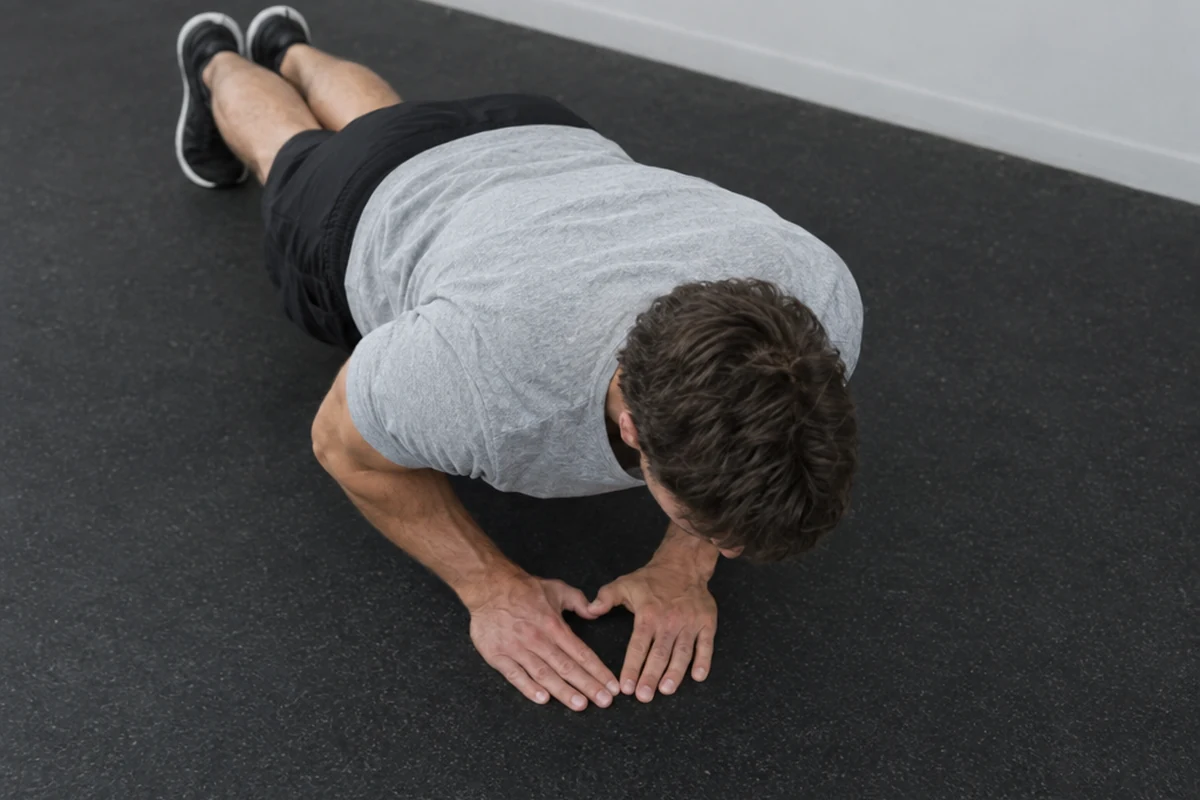
Image: generated with AI (GPT Image 2.5 Flare via Venice). No free licence photo of this hand position exists on Wikimedia, Commons or Openverse.
A diamond push-up is a push-up with the hands together under the chest, thumbs and index fingers forming a triangle. Bringing the hands in raises the work for the triceps and the chest together, so it is a harder push-up rather than a way to train the arms on their own.
 Say where you stand. RepMaxing sets the target. coming soon
 What is a diamond push-up?
A diamond push-up is a push-up performed with the hands together under the chest, thumbs and index fingers touching so the gap between them makes a triangle. Everything else matches the standard described in how to do push-ups for beginners: one straight line from head to heels, chest down to the hands, elbows locked out at the top.
The hands are the only variable. They move from under the shoulders to under the sternum, and they move toward each other. Both of those changes matter, and the second one gets all the attention.
What does the narrow hand position actually change?
It raises the demand on the chest and the triceps at the same time. That is the finding people get backwards.
Cogley et al. (2005) had 40 participants, 11 men and 29 women, perform push-ups from a shoulder width, a wide and a narrow hand base while recording the pectoralis major and the triceps brachii. Activity was greater in both muscle groups from the narrow position than from the wide one. Their own conclusion was that a narrow base is the choice if the goal is greater muscle activation, with no suggestion that anything gets switched off.
Youdas et al. (2010) measured 20 people across the same 3 hand positions and reported the triceps brachii at 73 to 109 percent of a maximal contraction, the pectoralis major at 95 to 105 percent, the serratus anterior at 67 to 87 percent and the posterior deltoid at 11 to 21 percent. The narrow base was the most effective position for preferentially activating the triceps and the posterior deltoid.
Put those together and the picture is consistent. The narrow position gives the triceps a bigger share, and it raises the total, so the chest is working harder than it was in a standard push-up while receiving a smaller slice of a larger cake.
| Hand position | Triceps | Chest | What it is for |
|---|---|---|---|
| Wide base | Lowest of the 3 | Works, less than narrow | Little reason to choose it |
| Shoulder width | Middle | Middle | The default, see push-ups for beginners |
| Narrow, diamond | Highest share, per Youdas et al. (2010) | Higher than wide, per Cogley et al. (2005) | A harder push-up when the standard one runs out |
Why is the triceps isolation claim wrong?
The claim is wrong because no push-up isolates anything. The chest, the triceps and the serratus anterior all cross the same 2 joints being moved, and a hand position cannot remove one of them from the job.
What a hand position can do is shift proportions, and the size of that shift is smaller than the marketing. Both papers above describe changes in emphasis within an exercise that keeps the pectoralis major near the top of its range regardless. If you want an exercise where the triceps genuinely take the lead, that is the upright dip, covered in chest dips versus tricep dips.
The systematic review by Dhahbi et al. (2022) gathered kinetic data on 46 push-up variants from 26 studies, and the useful lesson from a list that long is that variants mostly change intensity. They rarely change which muscles are involved.
How much harder is it?
Harder enough that most people lose a third or more of their repetitions the first time, which is a rule of thumb rather than a measured figure. The hands move backward under the sternum, so the arms work against a longer lever, and the elbows travel closer to the ribs.
What has been measured is the family this sits in. Ebben et al. (2011) put 23 people through 6 push-up variations on a force platform and reported that raising the hands onto a 30.48 centimetre or a 60.96 centimetre box loaded the arms less than every other variation apart from the knee version. That is the dial to use here: the diamond position on a raised surface is the scaled version, exactly as in incline push-ups.
How do you scale them?
Scale them in 4 steps, keeping the hands together the whole way and changing only the height.
- Hands on a wall or a counter, in the diamond position.
- Hands on a low step or a sofa edge.
- Hands on the floor, knees down.
- Hands on the floor, full plank.
Widening the diamond slightly is the other dial, and it is the one to reach for if the wrists complain rather than the arms. A gap the width of your palm keeps most of the effect. Moving the hands back out to shoulder width turns it back into an ordinary push-up, which is a fine choice and a different exercise.
The mistake to avoid is letting the hips rise. When the triceps run out, the body wants to pike so the arms have less to lift, and the repetition stops counting. Film a set from the side if you are unsure, the same check that works for pike push-ups with the opposite problem.
When should you use them?
Use them once a standard push-up is comfortable for 10 clean repetitions, as your harder pushing option on 2 or 3 days a week, 3 sets of 6 to 10.
The repetition range is the American College of Sports Medicine’s recommendation for novices. The frequency comes from Grgic et al. (2018), whose meta-analysis reported strength gains rising from an effect size of 0.74 at 1 session a week to 0.93 at 3. The set count is a rule of thumb.
What decides the result is that the version keeps getting harder. Kotarsky et al. (2018) randomised 23 men to 4 weeks of progressive push-up variations or barbell bench press and reported significant bench press strength gains in both, with the bodyweight group improving more on its own test. The diamond push-up earns its place as one rung of that progression, and it stops paying the moment it becomes comfortable.
I added these the week my standard push-ups hit 25 and stopped being interesting, expecting to manage about 15. I got 8, and the eighth was ugly. What surprised me was the soreness: it was in the long head of the triceps and across the inner chest, which is exactly what both papers above would predict and not at all what the internet had told me to expect.
Where do they fit against the other options?
They fit as the cheapest way to make a push-up harder without equipment or a raised surface. The alternatives each do something different. Pike push-ups send the work to the shoulders. Dips load the chest and triceps more heavily than any push-up variant. Adding repetitions trains endurance rather than strength, and the targets for that are in how many push-ups a beginner should aim for.
The diamond push-up is a variation of one of the 3 movements I built RepMaxing around, and the app does not ask which variation you used. It takes the rep counts you enter for pull-up, push-up and dip, 0 included, and a goal workout is 6 sessions ending in 1 attempt at a target computed from those numbers and held fixed until you reach it. Diamond push-ups are one way to make the push day harder while that number climbs. The first goal workout, Foundation, is free.
Questions people actually ask
What muscles do diamond push-ups work?
The triceps and the chest, both harder than in a standard push-up. Cogley et al. (2005) recorded greater activity in the pectoralis major and the triceps brachii with a narrow hand base than with a wide one in 40 people, so the chest does not step aside when the hands come together.
Are diamond push-ups better for triceps?
They favour the triceps, without isolating them. Youdas et al. (2010) found the narrow hand position the most effective of 3 for preferentially activating the triceps brachii and the posterior deltoid, and the same push-up still put the pectoralis major at 95 to 105 percent of a maximal contraction.
Are diamond push-ups harder than regular push-ups?
Yes. The hands sit under the chest instead of under the shoulders, which lengthens the lever your arms work against and gives the triceps a larger share. Most people lose a third or more of their repetitions on the first attempt.
How many diamond push-ups should a beginner do?
3 sets of 6 to 10, as a rule of thumb, and only once a standard push-up is comfortable for 10. If you cannot manage 6, put your hands on a step and keep them together rather than moving them apart.
Why do my wrists or elbows hurt during diamond push-ups?
The narrow position turns the hands in and keeps the elbows close, which some joints dislike. Widen the diamond into a triangle the size of your palm, turn the fingers slightly outward, or use the same position on a raised surface until it settles.
Do diamond push-ups build bigger arms?
They build triceps strength, and size follows training that keeps getting harder rather than any single exercise. Kotarsky et al. (2018) showed progressive push-up variations raised bench press strength as much as barbell training over 4 weeks, and the word carrying that result is progressive.
Should the hands actually form a diamond?
Not exactly. Touching thumbs and index fingers is the strict version and the one most pictures show. A gap of a few centimetres between the hands gives almost the same effect and is kinder to the wrists, which is the version worth starting with.
References
- Comparison of muscle activation using various hand positions during the push-up exercise (Cogley et al., J Strength Cond Res, 2005)
- Comparison of muscle-activation patterns during the conventional push-up and Perfect Pushup exercises (Youdas et al., J Strength Cond Res, 2010)
- Kinetic analysis of several variations of push-ups (Ebben et al., J Strength Cond Res, 2011)
- Kinetic analysis of push-up exercises: a systematic review with practical recommendations (Dhahbi et al., Sports Biomech, 2022)
- Effect of progressive calisthenic push-up training on muscle strength and thickness (Kotarsky et al., J Strength Cond Res, 2018)
- American College of Sports Medicine position stand: progression models in resistance training for healthy adults (Med Sci Sports Exerc, 2009)
- Effect of resistance training frequency on gains in muscular strength: a systematic review and meta-analysis (Grgic et al., Sports Med, 2018)