blog
Pike Push-Ups: Moving the Load onto Your Shoulders
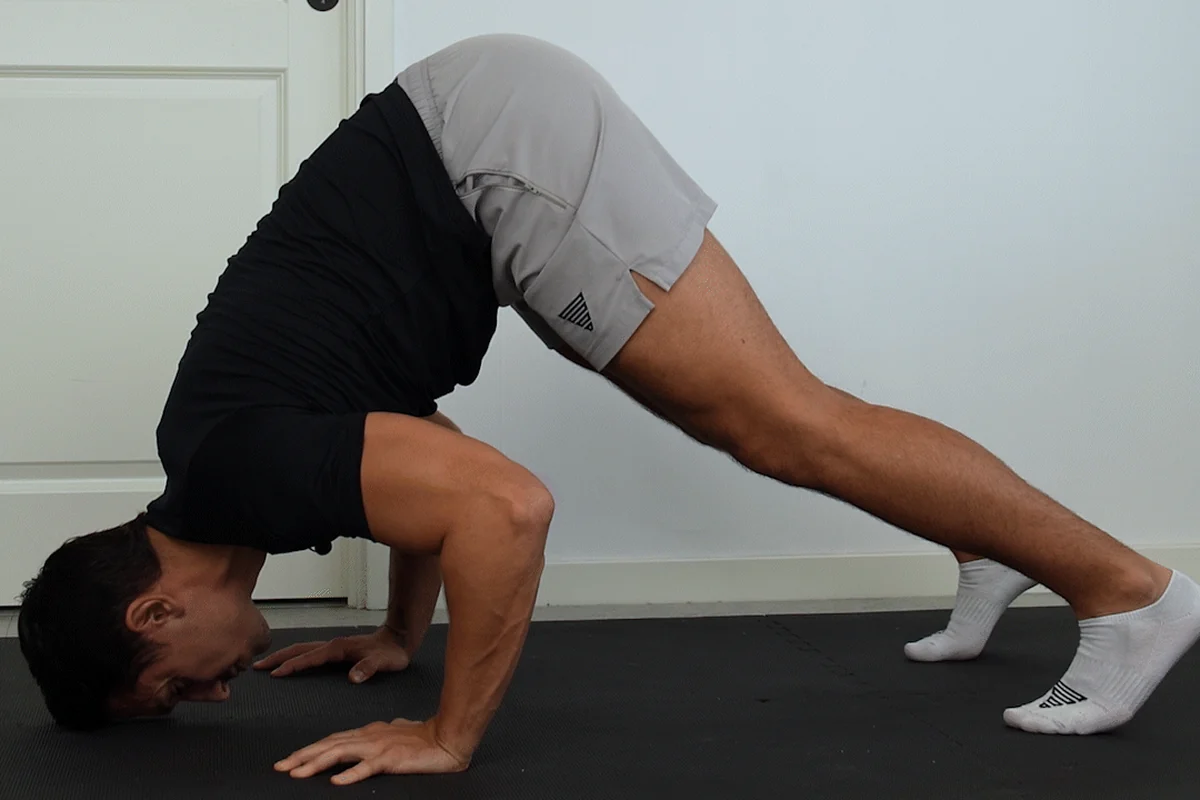
Photo: still from a video by Danielflefil, CC BY-SA 4.0, via Wikimedia Commons
A pike push-up is a push-up with the hips raised high, so the torso tips toward vertical and the shoulders carry more of the work than the chest. It is the usual step between the floor push-up and the handstand push-up, and it needs no equipment at all.
 Say where you stand. RepMaxing sets the target. coming soon
 What is a pike push-up?
A pike push-up is a push-up performed with the hips lifted high, so the body makes an inverted V and the head travels down toward the floor in front of the hands rather than straight down between them. Hands stay roughly shoulder width, legs stay straight or nearly straight, and the hips stay up for the whole set.
The only variable that separates it from the push-up in how to do push-ups for beginners is the angle of your torso. A flat push-up keeps the torso horizontal. A pike push-up tips it toward vertical, and everything else about the movement follows from that one change.
What does raising the hips actually change?
Raising the hips changes how much of your body weight the hands have to hold, and it changes the direction you press in.
The clearest measurement of the first part comes from Ebben et al. (2011), who put 23 recreationally fit people, 14 men and 9 women, through 6 push-up variations on a force platform. Raising the feet onto a 30.48 centimetre box and then a 60.96 centimetre box produced a higher peak ground reaction force than every other variation tested. Raising the hands, or dropping to the knees, produced a lower one. A pike push-up is on the first road: it moves weight toward the hands.
Suprak et al. (2011) measured 28 strength-trained men in 4 static push-up positions and put a mechanism under the result. What sets the load on the hands is the moment arm between the contact point at the feet and the hands. Shorten that distance by walking the feet in and lifting the hips, and the hands take more.
The direction matters just as much. In a flat push-up you press the floor away from your chest. In a pike push-up your torso is steep enough that you are pressing more or less overhead, which is a different job for the shoulder.
| Position | What the hands carry | What it is good for |
|---|---|---|
| Hands raised on a step | Least, per Ebben et al. (2011) | The first repetitions, see incline push-ups |
| Flat push-up | The middle of the range | Chest and triceps |
| Pike, feet on the floor | More than flat | Learning the overhead press angle |
| Pike, feet raised on a step or chair | Most, the feet-elevated case | Building toward the handstand push-up |
Which muscles does a pike push-up work?
A pike push-up works the shoulders and triceps first, with the chest contributing less than it does in a flat push-up. That ordering is reasoning from the position rather than a measured result, and the honest statement is that nobody has put the pike push-up on a force platform or under electrodes. The systematic review by Dhahbi et al. (2022) pulled kinetic data on 46 push-up variants from 26 studies, and the pike version is not among them.
What is measured is the push-up it grows out of. Youdas et al. (2010) recorded surface electromyography in 20 people during push-ups and reported the triceps brachii at 73 to 109 percent of a maximal contraction, the pectoralis major at 95 to 105 percent, the serratus anterior at 67 to 87 percent and the posterior deltoid at only 11 to 21 percent.
That last number is the interesting one. A flat push-up barely touches the back of the shoulder, and it asks the chest for roughly as much as the triceps. Tipping the torso up is how you change that balance without adding equipment. Be careful with how far anyone stretches this: Youdas measured the posterior deltoid, not the front of the shoulder that does the pressing, so the study tells you what the flat push-up leaves out rather than what the pike version puts in.
How do you build up to one?
Build up in 4 steps, and move on only when the current step is comfortable.
- Hold the shape. Get into the inverted V with straight arms and hold for 20 to 30 seconds, as a rule of thumb. If your shoulders or hamstrings object to the position itself, that is the thing to fix first.
- Press from a raised surface. Hands on a low step or a sofa edge shortens the range and takes weight off, the same principle as incline push-ups.
- Pike push-ups from the floor. Feet on the ground, hips as high as you can hold them.
- Feet raised. A step, then a chair. Each lift tips the torso closer to vertical and, by the Ebben et al. (2011) result, puts more of you over your hands.
A useful check before any of this: can you hold a plank with the shoulder blades set rather than collapsed? The control drilled in scapular push-ups is what keeps the shoulder organised once the torso goes steep, and it is cheap to train.
How should you program them?
Program them as your pressing work on 2 or 3 days a week, 3 sets of 6 to 10 repetitions at the hardest version you can hold form in.
The repetition range is the American College of Sports Medicine’s recommendation for novices. The frequency comes from Grgic et al. (2018), whose meta-analysis reported strength gains rising from an effect size of 0.74 at 1 session a week to 0.93 at 3. The set count is a rule of thumb.
What matters more than the numbers is that the version gets harder over time. Kotarsky et al. (2018) randomised 23 men to 4 weeks of progressive push-up variations or barbell bench press and reported significant bench press strength gains in both groups, with the bodyweight group improving more on its own test. The word doing the work in that result is progressive. Ten pike push-ups from the floor every session for 3 months builds very little after the first fortnight.
When you can manage 10 clean repetitions, raise the feet rather than chasing 15. Where this sits in a full week is in the beginner calisthenics workout plan.
What goes wrong most often?
Four things go wrong, and all of them are visible from the side.
- The hips drop. As soon as the hips sink, it becomes an ordinary push-up with a tired back. Film a set from the side and check the shape at the bottom, not at the top.
- The head goes down instead of forward. The head should land in front of the hands, roughly where a triangle would close. Straight down turns it into a short, cramped push-up.
- The elbows flare wide. Keep them tracking at a moderate angle from the ribs, the same standard as in a flat push-up.
- The wrists complain. More weight on a more bent wrist is the whole point of the exercise and also its main annoyance. Turning the hands out slightly, or raising them on 2 books, keeps the joint straighter.
I put a set on video the first week I tried these, expecting the shoulders to be the limit, and my hips were 20 centimetres lower at the bottom of every repetition than they were at the top. The shoulders were never tested. That is why the first bullet is the first bullet, and why I now treat the hip height at the bottom as the number that decides whether the set counted.
Where do pike push-ups lead?
They lead to the handstand push-up, by raising the feet until the torso is vertical and the wall takes the balance. That is a long road, and it is worth saying plainly that it leaves the 3 movements this site is built around.
If your goal is the pressing strength rather than the skill, the shorter route is the dip. It loads the chest and triceps heavily from the start, and the entry standards are in dips for beginners. If your goal is repetitions on the flat push-up, the targets are in how many push-ups a beginner should aim for.
The pike push-up is not one of the movements I built RepMaxing around. The app takes the rep counts you enter for pull-up, push-up and dip, 0 included, and a goal workout is 6 sessions ending in 1 attempt at a target computed from those numbers and held fixed until you reach it. Pike push-ups are what you do with the push day once the flat version stops being the limit. The first goal workout, Foundation, is free.
Questions people actually ask
What is a pike push-up?
A push-up performed with the hips lifted high, so your body makes an inverted V and your head travels toward the floor in front of your hands rather than straight down. The steeper the torso, the more the shoulders take over from the chest.
What muscles do pike push-ups work?
Mainly the shoulders and triceps, with the chest doing less than in a flat push-up. Nobody has put the pike version on a force platform, so the split is reasoning from the position rather than a measured number. The flat push-up it builds on is well measured: Youdas et al. (2010) recorded the triceps at 73 to 109 percent of a maximal contraction.
Are pike push-ups harder than normal push-ups?
Yes, because more of your weight sits over your hands. Ebben et al. (2011) tested 6 push-up variations and found the versions with the feet raised produced a higher peak ground reaction force than every other variation, including the standard push-up.
How many pike push-ups should a beginner do?
3 sets of 6 to 10, at whatever hip height you can control, as a rule of thumb. If you cannot reach 6, lower the hips a little or put your hands on a step. If 10 feels easy, raise the feet instead of adding repetitions.
Do pike push-ups build up to handstand push-ups?
They are the standard route to one. Raising the feet onto a step, then a chair, then a wall tips the torso closer to vertical each time, and the handstand push-up is the end of that road with the torso fully upright.
Why do my wrists hurt during pike push-ups?
Because the hand is bent further back than in a flat push-up, and more weight sits on it. Try turning the hands out slightly, gripping the floor with the fingers, or raising the hands on 2 books or parallettes so the wrist stays straighter.
Are pike push-ups the same as a downward dog?
The starting shape is similar, but a downward dog is a held stretch with straight arms, while a pike push-up bends and straightens the elbows for repetitions. Holding the top position is a reasonable way to get used to the shape before pressing.
References
- Kinetic analysis of several variations of push-ups (Ebben et al., J Strength Cond Res, 2011)
- The effect of position on the percentage of body mass supported during traditional and modified push-up variants (Suprak et al., J Strength Cond Res, 2011)
- Kinetic analysis of push-up exercises: a systematic review with practical recommendations (Dhahbi et al., Sports Biomech, 2022)
- Comparison of muscle-activation patterns during the conventional push-up and Perfect Pushup exercises (Youdas et al., J Strength Cond Res, 2010)
- Effect of progressive calisthenic push-up training on muscle strength and thickness (Kotarsky et al., J Strength Cond Res, 2018)
- American College of Sports Medicine position stand: progression models in resistance training for healthy adults (Med Sci Sports Exerc, 2009)
- Effect of resistance training frequency on gains in muscular strength: a systematic review and meta-analysis (Grgic et al., Sports Med, 2018)