blog
Chair Dips: The First Dip, and When to Leave It
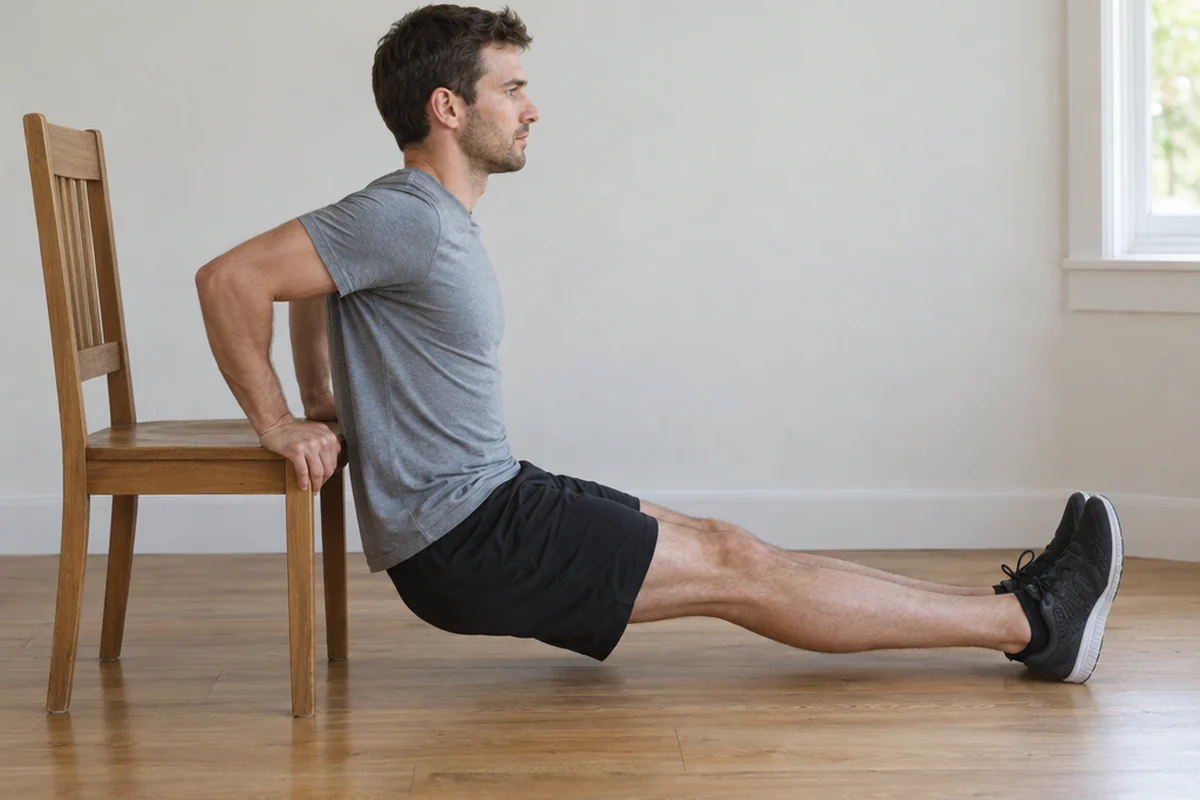
Image: generated with AI (GPT Image 2.5 Flare via Venice). No free licence photograph of a chair dip exists on Wikimedia, Commons or Openverse.
A chair dip is a dip performed with your hands on the edge of a chair behind you and your feet on the floor. It trains the triceps first, it is the easiest dip there is, and it is meant as a starting point: once 15 clean reps with straight legs are routine, the parallel bars are the next step.
 Say where you stand. RepMaxing sets the target. coming soon
 What is a chair dip?
A chair dip is a dip performed with your hands on the front edge of a chair behind you, your feet on the floor in front, and your body lowered and raised by bending and straightening the elbows. It is the same movement as the bench dip, done on the piece of furniture most people have.
It is the first rung of the dip, before the bars covered in dips for beginners. The legs carry part of your weight, which is exactly why it works as a start and exactly why it stops working after a while.
What does a chair dip train?
A chair dip trains the triceps first, with the front of the shoulder and some chest helping. The best measurement comes from McKenzie et al. (2022), who put 13 experienced men through bench, bar and ring dips with motion capture and surface electromyography. They described the bench version, the same movement as a chair dip, as predominantly targeting the triceps brachii.
| Dip | Peak triceps activation | What it asks of the shoulder |
|---|---|---|
| Bench or chair dip | 0.83 mV | The greatest range of shoulder extension of the 3 |
| Bar dip | 1.04 mV | Less extension, more of your weight |
| Ring dip | 1.05 mV | Like the bar, plus the rings moving |
The numbers come from the same study. They show the chair as the lighter end, and the authors called the bar dip “an appropriate progression from the bench dip due to the higher peak muscle activations”. The chair is where you start, not where you stay.
How do you set up the chair safely?
Set it up so it cannot move, because a chair that slides at the bottom of a dip is how people hurt their wrists.
- Pick a heavy chair with 4 legs and a flat seat. No wheels, no folding chairs, nothing that rocks.
- Push its back against a wall. The wall stops it sliding away from you.
- Hands on the front edge, fingers forward, shoulder width or slightly narrower.
- Slide your hips off the seat so your back stays close to the edge all the way down.
- Lower until your upper arms are about parallel with the floor, then press back to straight arms.
That depth is a rule of thumb, and it matters more here than on the bars. McKenzie et al. (2022) found the bench dip needs a greater range of shoulder extension than bar or ring dips. Going deeper than parallel adds little for the triceps and a lot for the front of the shoulder.
How do you make chair dips harder?
Make them harder by moving your feet, because the feet decide how much of your weight the arms carry. These steps are a rule of thumb rather than measured loads, ordered from easiest to hardest.
| Step | Feet | Move on when |
|---|---|---|
| 1 | Knees bent, feet flat close to the chair | 3 sets of 12 feel easy |
| 2 | Knees bent, feet further out | 3 sets of 12 feel easy |
| 3 | Legs straight, heels down | 3 sets of 15 feel easy |
| 4 | Feet raised on a second chair | 3 sets of 10 feel easy |
| 5 | Parallel bars | See dips for beginners |
Progressing is what turns a chair dip into strength. Kotarsky et al. (2018) randomised 23 men to 4 weeks of progressive push-up variations or barbell bench press and reported significant bench press strength gains in both groups, with the bodyweight group improving more on its own test. That was push-ups, not dips, but the principle carries: the exercise keeps working as long as the version keeps getting harder.
How often should you do them?
Do them 2 or 3 times a week, 3 sets of 8 to 12 at the hardest step you can hold form in. The repetition range is the American College of Sports Medicine’s recommendation for novices. The frequency comes from Grgic et al. (2018), whose meta-analysis reported strength gains rising from an effect size of 0.74 at 1 session a week to 0.93 at 3. The set count is a rule of thumb.
Chair dips sit on the push days of the beginner calisthenics workout plan, next to push-ups. The two complement each other: the push-up gives more to the chest, the dip more to the triceps.
What goes wrong most often?
Three things go wrong, and you can see all of them from the side.
- The hips drift away from the chair. Your back should brush the seat edge on the way down. When the hips move forward, the shoulders roll forward with them and the dip turns into a shoulder stretch under load.
- The shoulders shrug up to the ears. Keep them pressed down. If they rise at the bottom, the depth is too much for now.
- The legs do the work. With bent knees it is easy to push up through the feet. If your legs feel tired before your arms, move the feet back towards the chair and slow down.
The depth mistake is the one worth taking seriously, because it feels like effort. Elbows far past parallel make a set feel harder, but the extra range is shoulder extension, which McKenzie et al. (2022) found the bench version already demands more of than any other dip.
When should you move on to the bars?
Move on when 3 sets of 15 with straight legs feel routine, as a rule of thumb. At that point your legs carry less and less, but the chair can never take them out of it entirely, so it stops being hard enough.
The bar dip then takes your full weight. McKenzie et al. (2022) had 15 men take bar dips to exhaustion and found the movement stays technically stable as fatigue sets in, with activation in the chest and triceps rising rather than the form falling apart. That makes it a good next step to train hard. Where the lean goes after that is in chest dips versus tricep dips, and the dip half of a much later goal is in how to do a muscle-up.
The dip is 1 of the 3 movements I built RepMaxing around, with the pull-up and the push-up. The app takes the rep counts you enter for each, 0 included, and a goal workout sets a target computed from those numbers. Chair dips are how a dip count of 0 becomes a number worth entering. The first goal workout, Foundation, is free.
Questions people actually ask
What muscles do chair dips work?
Mainly the triceps, with the front of the shoulder and some chest. McKenzie et al. (2022) measured the bench version, which is the same movement off a bench, and described it as predominantly targeting the triceps brachii.
Are chair dips bad for your shoulders?
They put the shoulder further back than any other dip. McKenzie et al. (2022) found the bench version needs a greater range of shoulder extension than bar or ring dips. Keep the depth to where your upper arm is roughly parallel with the floor, and stop if the front of the shoulder hurts.
How many chair dips should a beginner do?
3 sets of 8 to 12 at whichever foot position lets you hold form, as a rule of thumb. When 12 is easy, change the foot position instead of adding reps.
Are chair dips as good as bar dips?
No, they are easier. McKenzie et al. (2022) recorded peak triceps activation at 0.83 millivolts on the bench against 1.04 on the bar, and called the bar dip the appropriate progression from the bench dip.
What kind of chair should I use?
A heavy chair without wheels, with four legs and a flat seat, pushed against a wall so it cannot slide. Folding chairs, office chairs and anything that rocks are out.
Should my legs be straight or bent?
Bent at first, straight later. Bent knees with feet flat take more of your weight through the legs. Straight legs with heels down make it harder, and feet raised on a second chair harder again.
When should I move to parallel bars?
When 3 sets of 15 with straight legs feel routine, as a rule of thumb. At that point the chair has stopped being hard enough to build much more strength.
References
- Bench, bar, and ring dips: do kinematics and muscle activity differ? (McKenzie et al., Int J Environ Res Public Health, 2022)
- Fatigue increases muscle activations but does not change maximal joint angles during the bar dip (McKenzie et al., Int J Environ Res Public Health, 2022)
- Effect of progressive calisthenic push-up training on muscle strength and thickness (Kotarsky et al., J Strength Cond Res, 2018)
- American College of Sports Medicine position stand: progression models in resistance training for healthy adults (Med Sci Sports Exerc, 2009)
- Effect of resistance training frequency on gains in muscular strength: a systematic review and meta-analysis (Grgic et al., Sports Med, 2018)